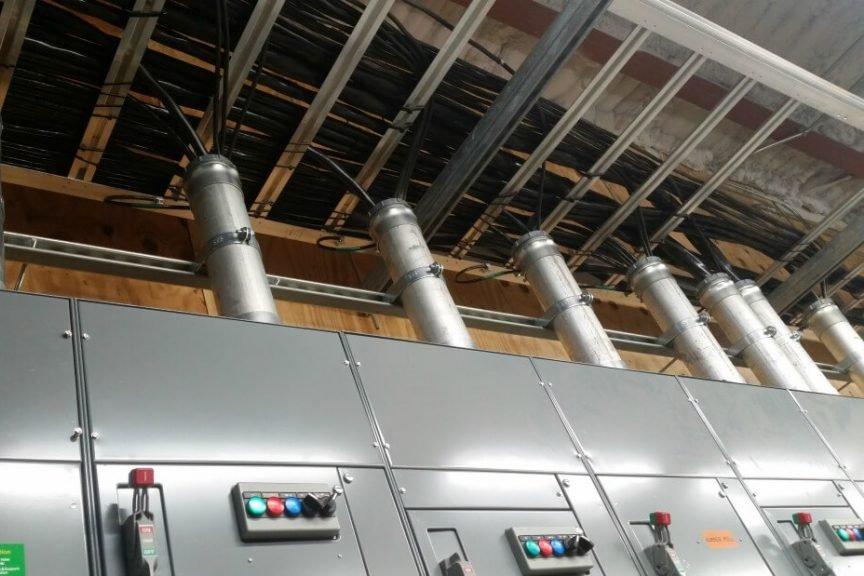
Improving Critical Motor Reliability With Continuous Insulation Monitoring
How do you improve the reliability of a critical motor without taking it out of service more often? Sack recently completed a project for a large electrical power provider that helped improve the safety and reliability of their critical motor systems. This solution is applicable to many facilities that rely on critical motor-driven equipment.
A critical motor-driven system is any motor that performs a function essential to preventing hazards to business, health, safety, or environment. It’s a motor that must run when called upon. It’s been assigned a level of availability by management, and you must achieve that reliability goal. Motors typically found in this category are drivers for lube oil pumps, cooling water pumps, cooling fans, compressors for chillers, charge pumps, fire pumps, and many others. Some facilities consider all their motors critical.
Anyone involved with reliability engineering knows there are two primary ways to improve system reliability:
1. Add a redundant system in parallel
2. Make the existing system more reliable by using more reliable components and increasing the maintenance frequency
Option 1. is rarely practical, particularly with existing facilities as it requires a lot of space and a large investment. So, let’s focus on item 2. Selecting reliable equipment and using proven installation methods are always desirable, and Sack can assist with both. However, those provide marginal improvements and with existing installations it may not be practical.
So how do you increase the frequency of maintenance? The most common offline maintenance for motors is manual insulation resistance testing. This is where a current-limited DC test voltage is applied to the conductors and the insulation resistance to ground is calculated in megohms. This is an effective method of testing the health of the insulation, the useful life left of the equipment, and determining if the motor is safe to energize.
This form of testing can be costly, especially if you increase the frequency to achieve your reliability goals. It requires manpower, permitting, coordination, and removing the motor from service so it is not available if called upon. Additionally, it exposes personnel to potential hazards during the LOTO and testing process. It also only provides data for that moment in time and test results can vary depending on the personnel, equipment used, and the environmental conditions at the time.
All of these can be avoided by installing an automatic, offline, continuous insulation resistance tester and monitor. Meg-Alert has devices that will continuously monitor insulation resistance whenever the motor is offline. This is accomplished by automatically applying a current-limited DC test voltage of 500, 1000, 2500, or 5000 volts DC. It calculates the insulation resistance and has 2 form C contacts. One contact changes state when the insulation resistance drops below 50 megohms. This is commonly used for alarm. The second contact changes state when the insulation resistance drops below 5 megohms. This is typically inserted in the trip or start permissive circuit to act as a block start.
The actual resistance value can also be displayed with either an analog or digital meter, depending on what you prefer to see. The digital meter may be equipped with a 4-20 mA output signal that can be utilized with existing data collection systems to trend and track the readings.
If your facility has critical motor-driven equipment and you're looking to improve reliability while reducing maintenance effort, we'd be happy to discuss your application and determine whether this approach is a good fit.
This content is intended for informational purposes only and should not be relied upon as engineering advice or design guidance for any specific project. All content is the intellectual property of The Sack Company.
Interested in a career with us?
We Bring Careers to Life
At Sack Company, we are building more than projects; we are building futures. Through delivering expert industrial and MEPF services across the Southeast, we provide an exceptional career pathway supported at every step by training and mentorship.